
Why Deploying to the Cloud Is Still Too Hard in 2026 (And What to Do About It)
Cloud computing transformed software development. Infrastructure that once required physical servers, networking hardware, procurement cycles, and operations teams can now be provisioned in minutes. Platforms like Amazon Web Services, Google Cloud Platform, and Microsoft Azure made global-scale infrastructure accessible to startups, independent developers, and growing teams in ways that would have been unimaginable a decade ago.
From the outside, it looks like cloud infrastructure should already be simple.
Applications can scale automatically. Databases can be provisioned instantly. Entire environments can theoretically be deployed with a few commands. The tooling ecosystem surrounding the cloud has matured enormously, and yet one frustrating reality continues to exist across the industry:
Deploying software to the cloud is still far harder than it should be.
Not because the cloud lacks capability, but because modern infrastructure has become operationally overwhelming. The complexity no longer comes from acquiring infrastructure. It comes from coordinating, understanding, and managing the growing number of moving parts that surround modern deployments.
The Cloud Didn’t Remove Complexity — It Redistributed It
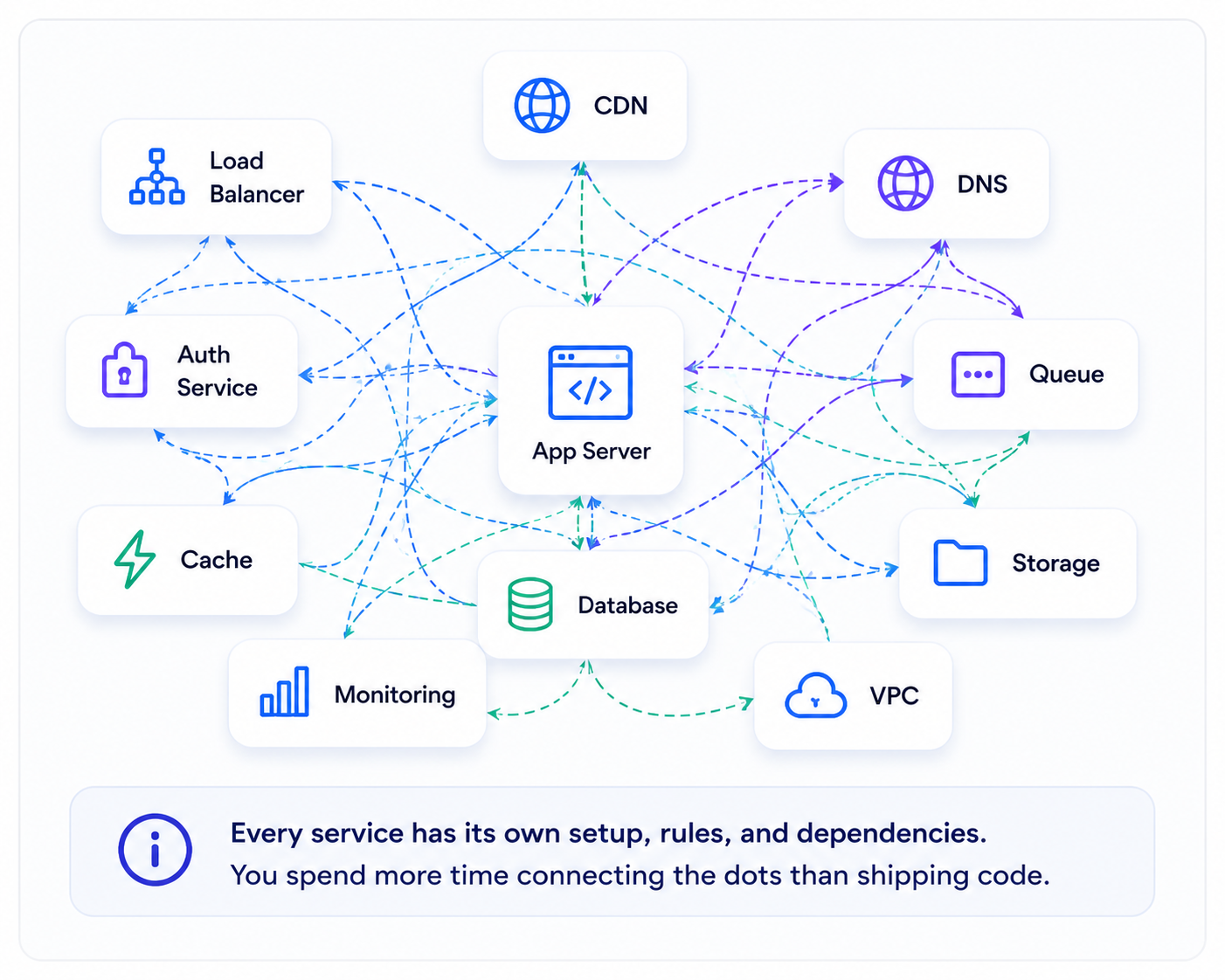
One of the biggest misconceptions about cloud computing is that it simplified infrastructure. In reality, the cloud largely shifted infrastructure complexity away from hardware management and into operational workflows.
Years ago, teams struggled with provisioning servers and maintaining physical infrastructure. Today, those problems are mostly abstracted away by cloud providers. But in their place came an entirely new layer of complexity centered around orchestration, configuration, permissions, networking, scalability, monitoring, and deployment automation.
A modern application is rarely just “an application” anymore. Even relatively small products often depend on a web of interconnected services: compute instances, databases, storage systems, load balancers, queues, monitoring pipelines, CI/CD workflows, DNS providers, security policies, and distributed environments. Individually, these systems are manageable. Together, they become difficult to reason about.
Developers are no longer simply deploying code.
They are coordinating distributed infrastructure ecosystems.
And the more capable the cloud becomes, the more operational layers teams are expected to manage.
Developers Are Increasingly Forced Into Infrastructure Work
One of the most significant shifts in modern software development is how deeply infrastructure responsibilities have moved into the hands of developers themselves.
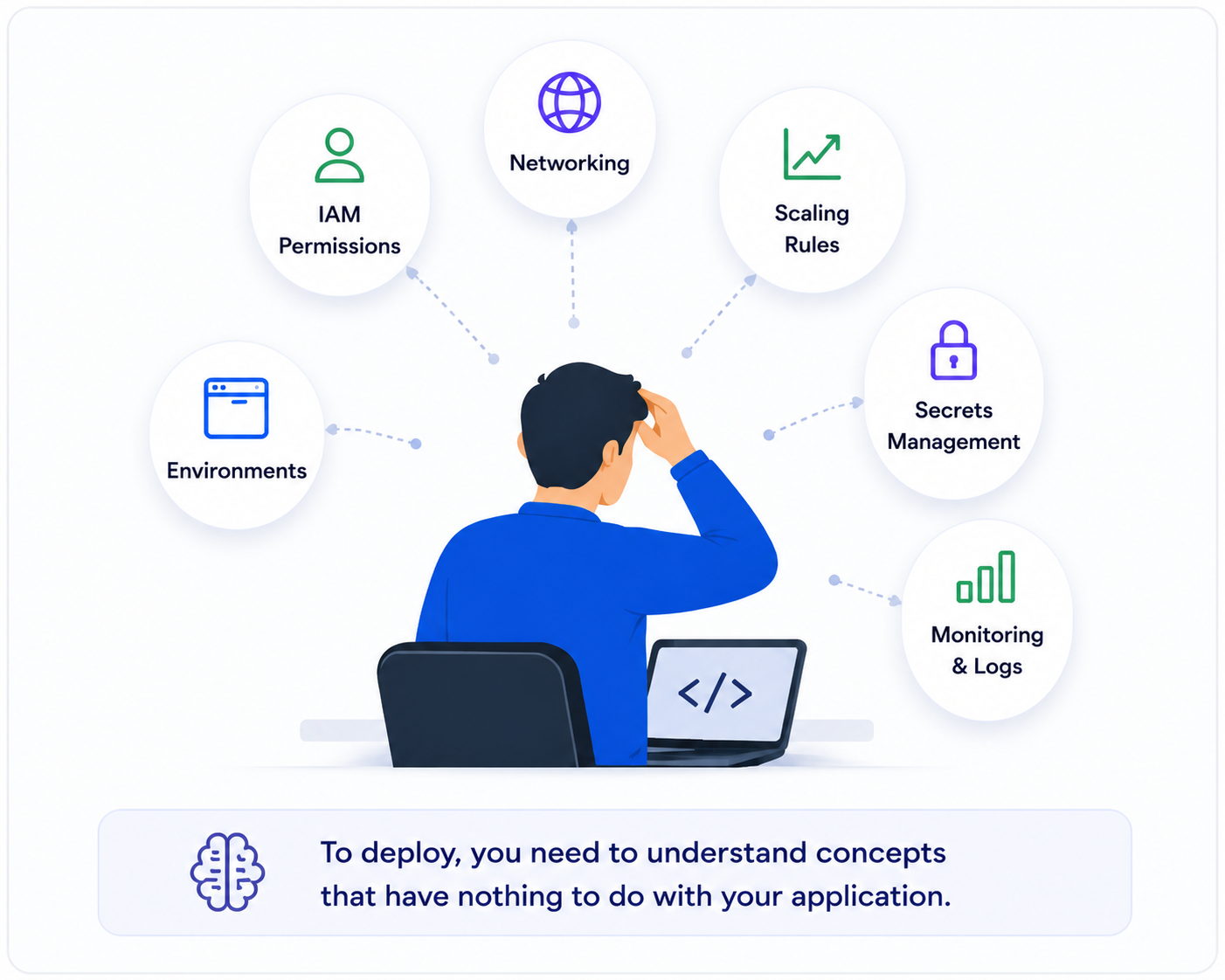
To deploy production-ready software in 2026, developers are often expected to understand concepts that historically belonged to specialized infrastructure or platform teams. Networking, IAM permissions, scaling rules, firewalls, environment isolation, secrets management, deployment orchestration, and cloud regions have become part of the day-to-day workflow for many engineering teams.
This creates a strange contradiction within the cloud industry.
The cloud was supposed to help developers focus more on building products. Instead, many developers now spend enormous amounts of time troubleshooting infrastructure behavior, debugging deployments, resolving permission issues, and navigating cloud provider tooling.
A frontend engineer launching a feature might suddenly need to investigate:
- Why a deployment pipeline failed
- Why an environment variable didn’t propagate
- Why traffic routing broke
- Or why permissions are preventing infrastructure access
The problem is not that developers are incapable of learning infrastructure concepts. The problem is that operational complexity now competes directly with product development for engineering attention.
Teams spend increasing amounts of time managing infrastructure instead of improving products.
Complexity Multiplies Across Tools
Cloud deployment complexity is rarely isolated inside a single platform. Modern infrastructure workflows are fragmented across entire ecosystems of tooling.
A typical deployment process today may involve:
- A cloud provider
- CI/CD systems
- Infrastructure automation tools
- Monitoring platforms
- Container orchestration
- DNS providers
- And secrets management systems
Each tool solves a specific operational problem. But collectively, they create a fragmented operational experience where developers constantly move between dashboards, logs, terminals, deployment pipelines, and configuration files just to understand what is happening.
This fragmentation introduces an enormous amount of mental overhead.
A deployment issue may involve:
- Infrastructure configuration
- Networking behavior
- Monitoring visibility
- Environment variables
- Or application runtime configuration simultaneously
As systems scale, understanding the relationships between these components becomes increasingly difficult.
Modern infrastructure is powerful, but operationally fragmented.
And fragmentation creates cognitive fatigue.
Infrastructure as Code Improved Automation — Not Usability
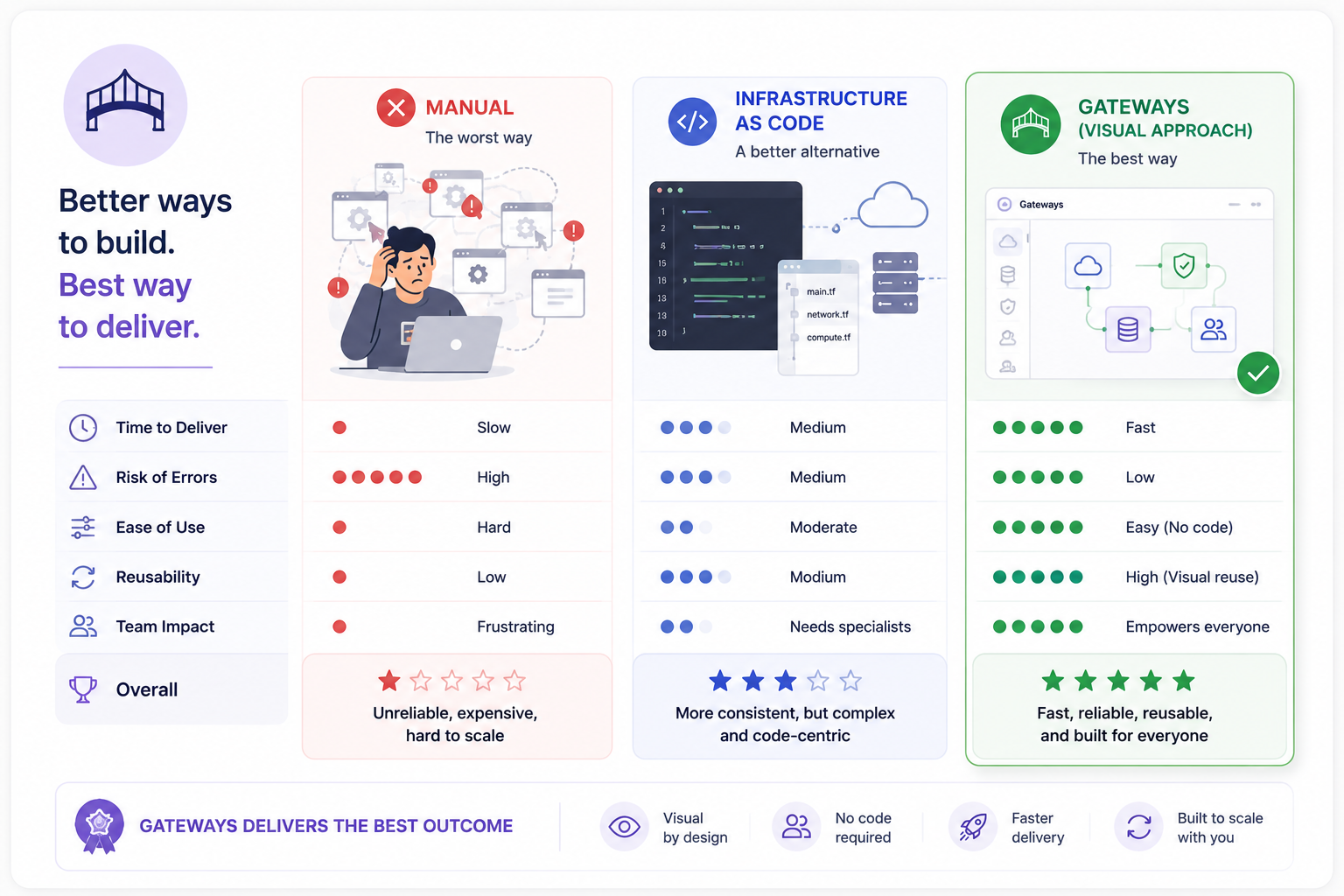
The rise of tools like Terraform was a major advancement for cloud operations. Infrastructure became programmable, repeatable, and version-controlled. Teams gained the ability to define environments consistently and automate infrastructure provisioning at scale.
That was a critical step forward.
But infrastructure as code primarily solved the problem of provisioning consistency. It did not fundamentally improve the day-to-day usability of infrastructure operations.
Infrastructure configuration files still grow increasingly large and interconnected. Dependencies still become difficult to visualize. Deployment workflows still involve planning, applying, syncing state, debugging drift, and resolving operational failures.
For large infrastructure teams, these workflows provide structure and repeatability.
But for fast-moving product teams, they often introduce additional operational friction into development cycles.
Developers frequently find themselves trapped in repetitive loops:
- Modify infrastructure
- Deploy
- Debug
- Rollback
- Retry
As systems become more interconnected, even small changes can create unexpected cascading effects across environments and services.
Infrastructure became easier to define, but not necessarily easier to operate.
Visibility Remains One of the Biggest Operational Problems
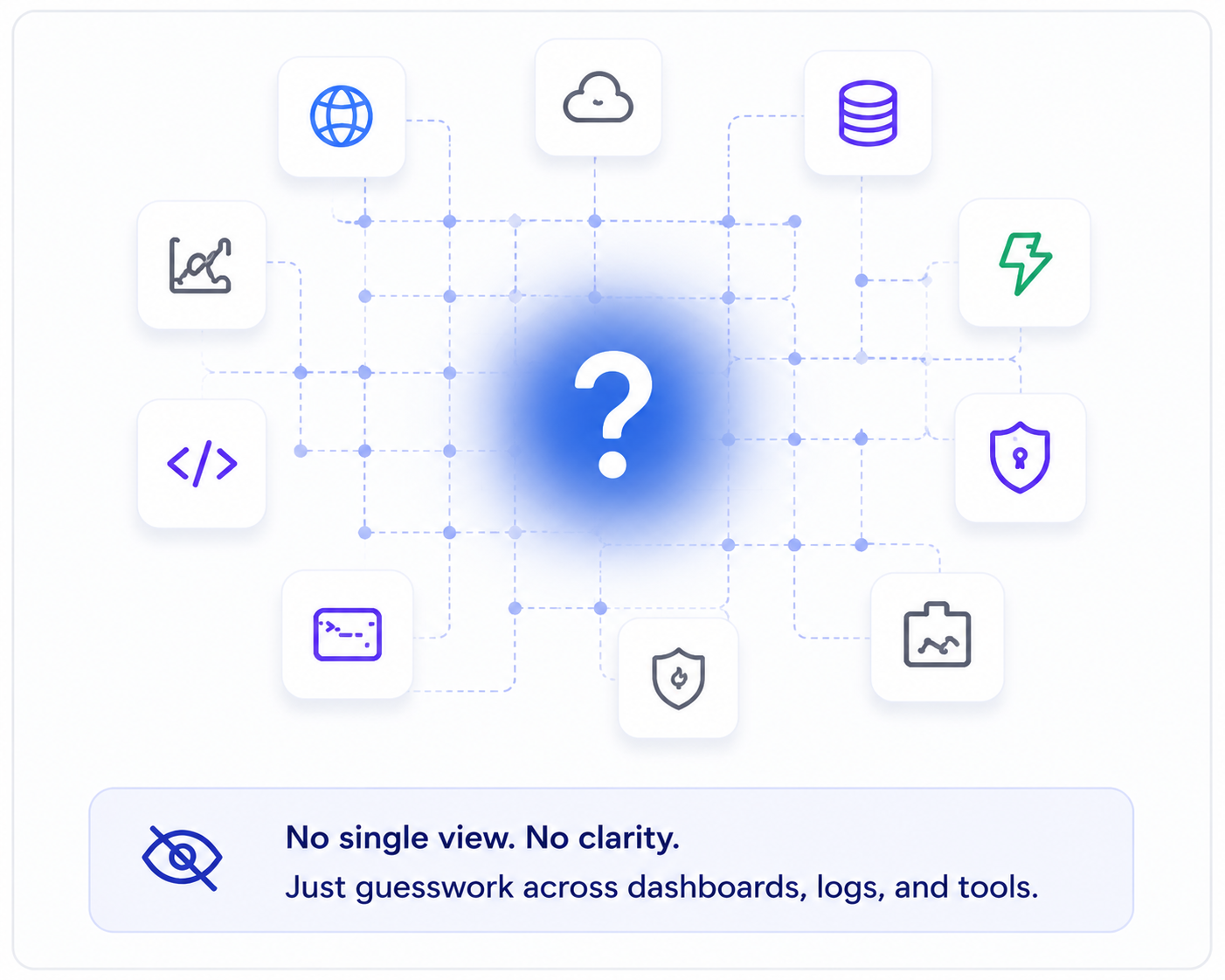
One of the most underestimated problems in cloud infrastructure is visibility.
Modern infrastructure is often difficult to fully understand because teams rarely have a clear, unified view of their systems. Instead, infrastructure exists across dashboards, configuration files, logs, monitoring tools, deployment pipelines, and cloud consoles.
This forces teams to mentally reconstruct how systems behave.
Developers constantly ask:
- Where is this service running?
- Which systems are connected?
- How is traffic flowing?
- Which deployment changed this behavior?
- Which environment is actually failing?
As infrastructure scales across multiple environments and regions, these questions become harder to answer quickly.
Operational complexity is not always caused by technical difficulty. Sometimes the difficulty comes from the inability to clearly visualize and reason about infrastructure itself.
Invisible complexity eventually becomes operational risk.
Security and Cost Management Add Additional Layers of Complexity
Security and cost optimization are now deeply intertwined with infrastructure operations, which adds further complexity to deployment workflows.
Cloud providers offer extremely granular security models, which is powerful but also difficult to manage correctly. Developers must constantly think about IAM policies, role permissions, environment isolation, network access, firewall rules, and secrets handling.
A single misconfiguration can:
- break deployments,
- expose infrastructure,
- or introduce vulnerabilities.
At the same time, cloud pricing has become increasingly difficult to predict as systems scale. Costs depend on infrastructure usage, scaling behavior, networking traffic, storage consumption, regional deployment choices, and service interactions.
The flexibility of the cloud comes with operational trade-offs:
- more responsibility,
- more configuration,
- and more optimization pressure.
Developers are no longer just shipping applications.
They are managing infrastructure risk, operational reliability, and financial efficiency simultaneously.
The Industry Created a Trade-Off Between Simplicity and Control
To escape infrastructure complexity, many teams moved toward platforms like:
- Vercel,
- Heroku,
- and Railway.
These platforms dramatically improved developer experience by reducing deployment friction and abstracting infrastructure management away from developers.
For many teams, this was transformative.
But these platforms introduced a different set of limitations around infrastructure ownership, operational flexibility, scalability constraints, and vendor dependency.
This created one of the most persistent trade-offs in modern cloud infrastructure:
| Approach | Benefit | Drawback |
|---|---|---|
| Raw Cloud Infrastructure | Full control and ownership | High operational complexity |
| Managed Platforms | Simplicity and speed | Reduced flexibility and lock-in |
Developers are often forced to choose between ease of use and infrastructure control.
Very few solutions successfully provide both.
The Real Problem Is the Infrastructure Experience
The cloud itself is not failing.
Modern infrastructure platforms are extraordinarily powerful. The real issue is that infrastructure evolved faster than the human experience surrounding it.
The industry optimized aggressively around:
- Scalability
- Automation
- Provisioning
- And distributed systems
But far less attention was given to:
- Visibility
- Usability
- Operational clarity
- And developer-centric workflows
As infrastructure systems continue growing more sophisticated, the operational experience surrounding them must evolve as well.
The future of cloud infrastructure will not simply be about more automation.
It will be about making infrastructure:
- Understandable
- Visual
- Operationally intuitive
- And easier for humans to manage
A Better Approach: Simplicity Without Losing Ownership
This is exactly the problem Gateways is designed to solve.
Instead of forcing teams to choose between:
- Raw infrastructure complexity
- Or heavily abstracted managed platforms
Gateways introduces a different approach:
Deploy simply, while still running inside your own cloud.
Gateways is built as a cloud operations console for infrastructure you own.
It combines the simplicity developers expect from modern deployment platforms with the flexibility and ownership of AWS, GCP, and Azure infrastructure.
Instead of jumping between disconnected tools and dashboards, teams can manage infrastructure visually through a unified operational layer.
Applications, databases, storage systems, networking, and environments become part of a live visual infrastructure workspace rather than fragmented operational systems.
Making Infrastructure Visual Instead of Invisible
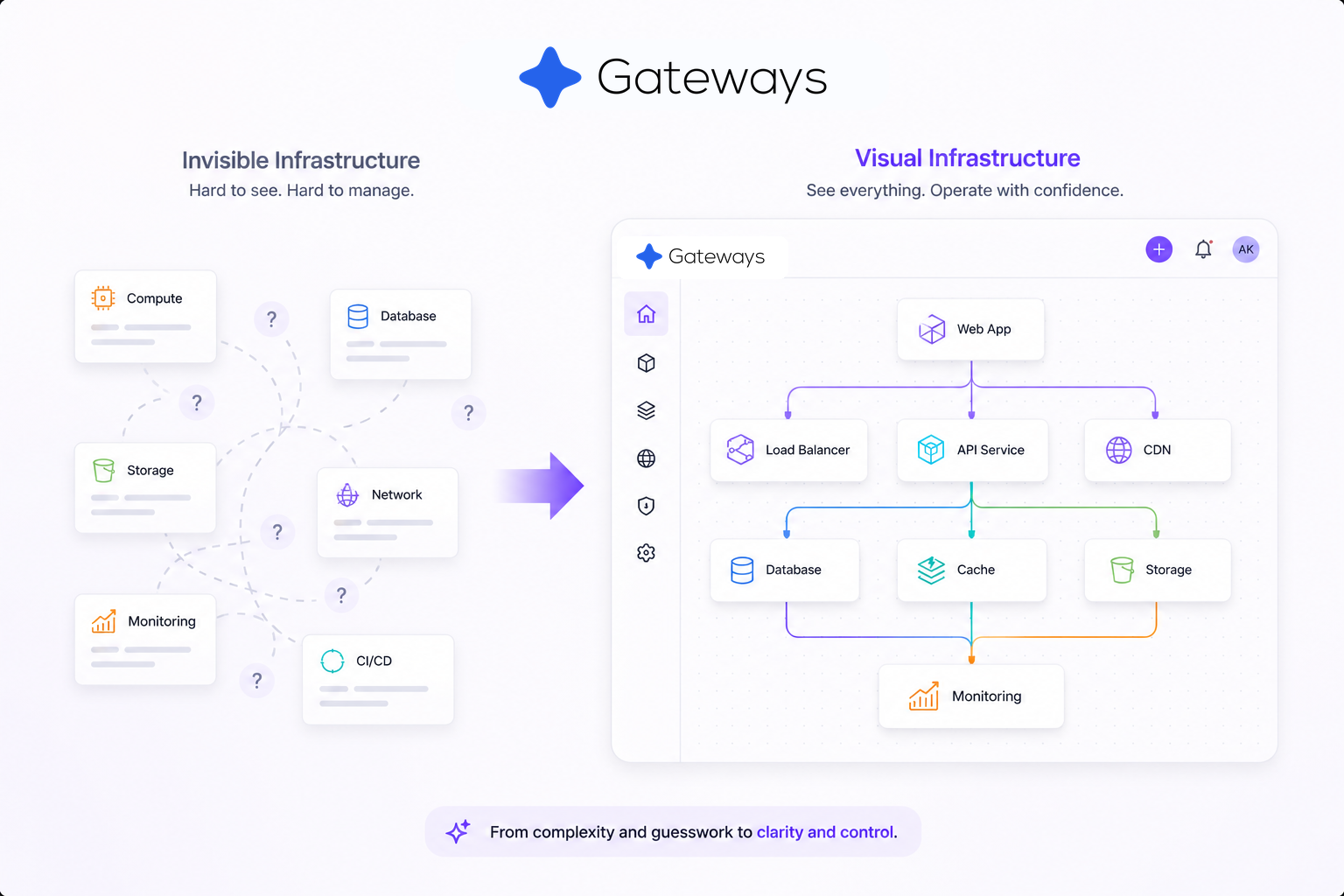
One of the biggest differences with Gateways is visibility.
Modern infrastructure is often difficult to reason about because relationships between systems remain hidden across dashboards and configuration layers.
Gateways changes this by turning infrastructure into a visual operational environment.
With Gateways, teams can:
- See how services connect
- Understand system relationships instantly
- Operate multi-region infrastructure visually
- And manage environments in real time
Instead of mentally reconstructing architecture from logs and dashboards, developers can interact directly with infrastructure as a connected system.
This dramatically reduces operational overhead and improves clarity across teams.
Many platforms attempt to simplify deployment by abstracting infrastructure away completely.
But abstraction alone is not always the answer.
At scale, teams still need:
- Visibility
- Ownership
- Flexibility
- And operational control
The goal should not be hiding infrastructure.
The goal should be making infrastructure understandable.
Repeatable Infrastructure Without Operational Headaches
Environment management is another major pain point in modern cloud operations.
Development, staging, QA, production, and multi-tenant systems frequently drift apart over time, creating deployment inconsistencies and operational bugs.
Gateways simplifies this through repeatable infrastructure templates and environment cloning.
Teams can:
- Clone full environments instantly
- Replicate infrastructure across regions
- Standardise deployments
- And reduce environment drift significantly
Instead of rebuilding infrastructure repeatedly, teams can reuse proven operational patterns.
Multi-Region Infrastructure Shouldn’t Feel Like a Different Discipline
As applications scale globally, infrastructure complexity increases dramatically.
Multi-region systems often require:
- Replication management
- Networking coordination
- Deployment synchronization
- And operational visibility across distributed environments
Traditionally, this introduces major operational overhead.
Gateways simplifies this by making multi-region infrastructure part of the same visual operational workflow rather than a separate infrastructure discipline.
Teams can deploy globally while still maintaining clarity and operational simplicity.
Final Thoughts
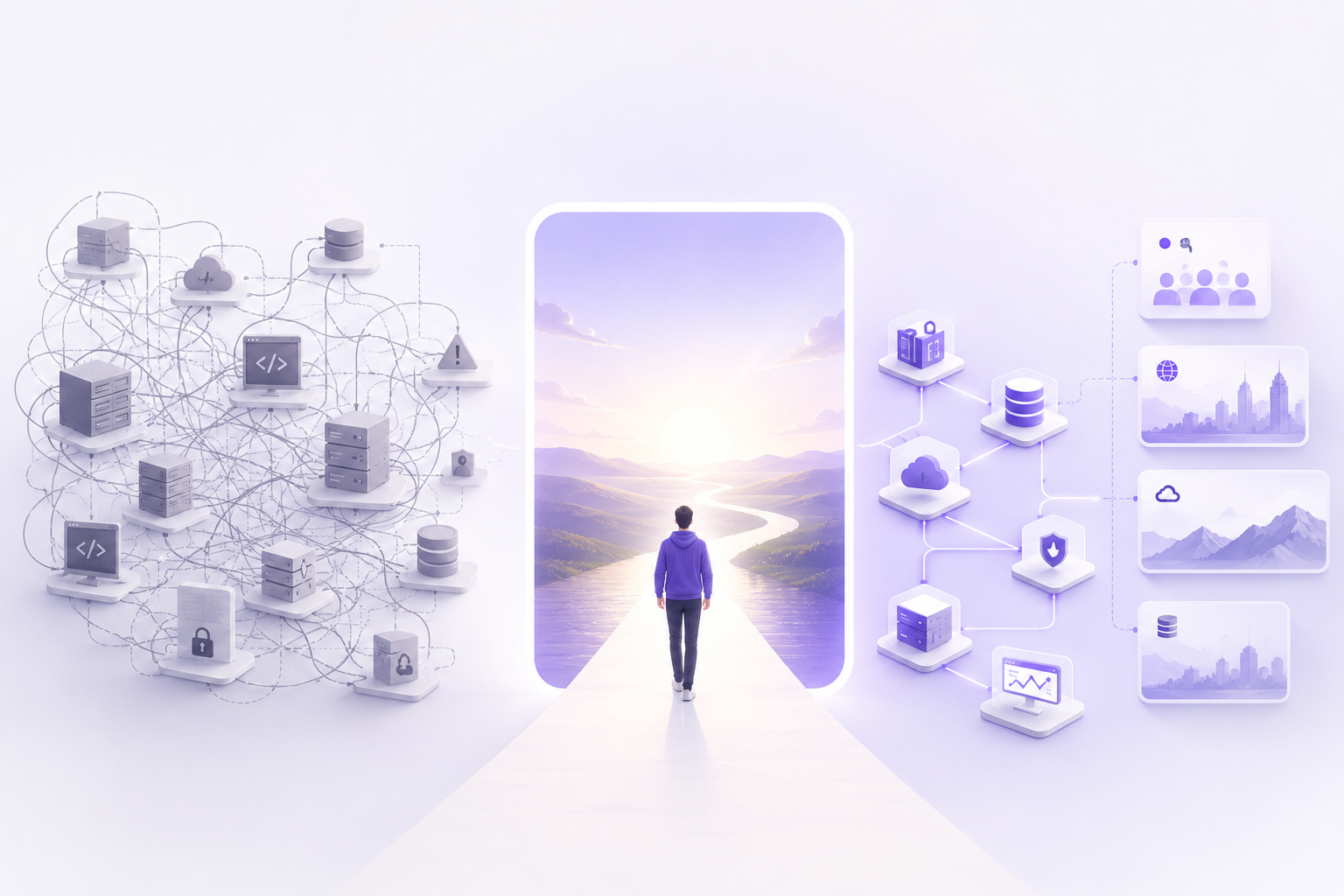
Cloud infrastructure is one of the most important technological advancements of the modern era. It unlocked scalability, global distribution, and unprecedented flexibility for software teams around the world.
But capability alone does not create simplicity.
In 2026, developers still spend enormous amounts of time:
- Configuring infrastructure
- Debugging deployments
- Managing permissions
- Coordinating environments
- And navigating fragmented operational workflows
The industry solved infrastructure availability.
Now it needs to solve infrastructure usability.
And that requires rethinking not just how infrastructure is provisioned but how humans interact with it. With Gateways, we are determined to change that.