
Render vs Gateways: The Difference Between Managed Hosting and Owning Your Cloud
Render simplifies deployment, but growing teams often hit limits around vendor lock-in, cloud flexibility, visibility, and rising costs. Discover how Gateways combines deployment simplicity with the freedom of running directly on your own AWS, Azure, or GCP infrastructure.
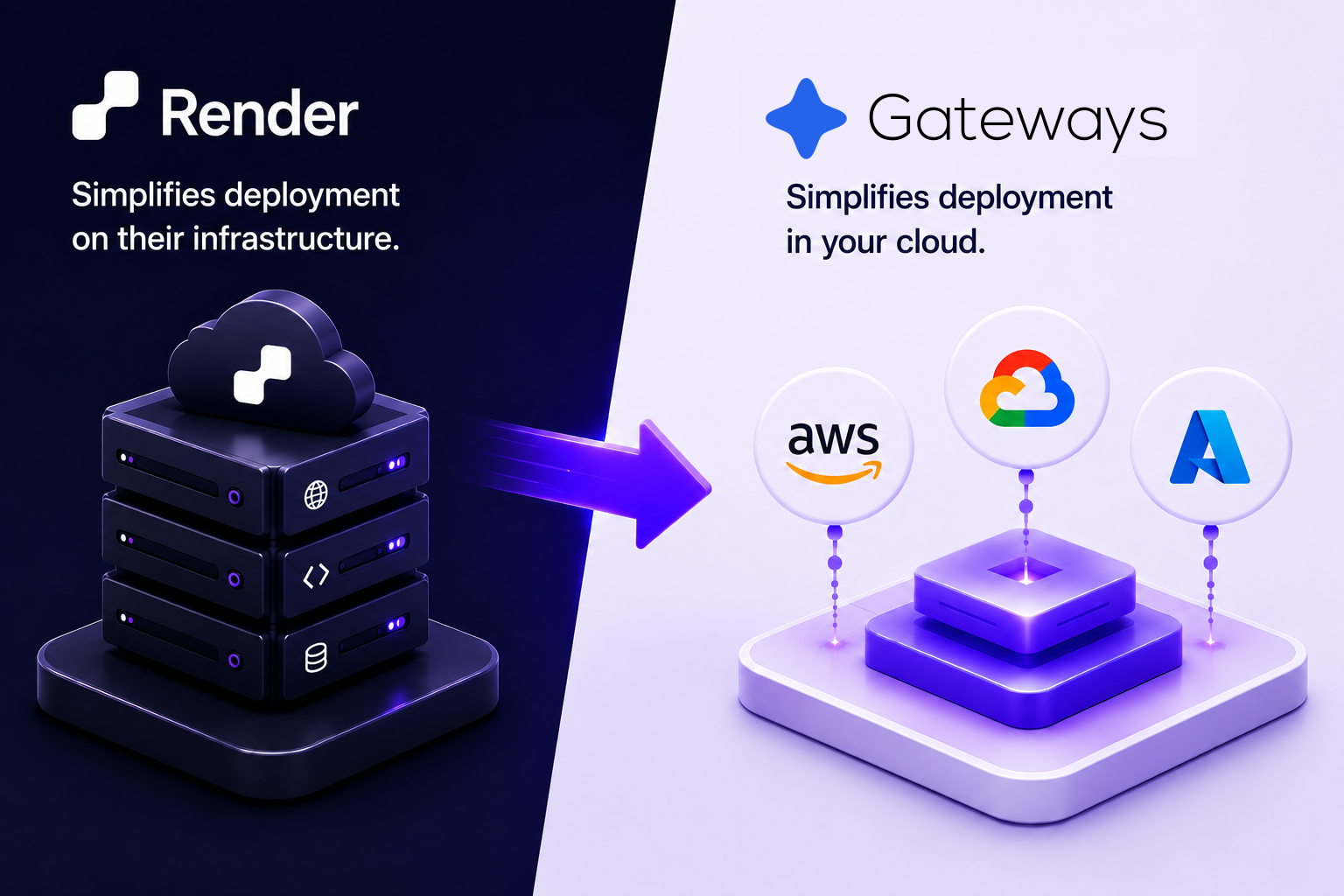
Modern deployment platforms have dramatically improved the developer experience over the past few years. Platforms like Render helped simplify application deployment by reducing the operational complexity traditionally associated with cloud infrastructure.
For many developers, this was a major improvement over manually configuring virtual machines, networking, deployment pipelines, databases and scaling infrastructure on raw cloud providers. Render made deployments feel more accessible.
But as teams grow, systems scale, and infrastructure requirements become more sophisticated, many organisations eventually encounter the limitations that naturally come with a fully managed platform model.
That’s where the difference between Render and Gateways becomes important.
Because while Render focuses on:
Simplifying deployment inside Render’s infrastructure,
Gateways focuses on:
Simplifying deployment inside your own cloud infrastructure.
And that difference changes everything:
- Ownership
- Flexibility
- Scalability
- Operational visibility
- And long-term infrastructure economics
🚀 What Render Does Well
Render deserves credit for improving cloud deployment workflows.
Its biggest strengths are:
- Git-based deployment simplicity
- Managed infrastructure
- Automatic SSL
- Built-in deployment workflows
- Preview environments
- And reduced operational overhead
For small applications and early-stage teams, this can feel significantly easier than managing infrastructure directly on Amazon Web Services, Google Cloud Platform or Microsoft Azure.
Instead of configuring infrastructure manually, developers can:
- Connect a repository
- Define services
- And deploy quickly
That convenience is valuable but the architectural trade-offs become more visible as systems mature.
⚠️ The Biggest Limitation of Render: You Don’t Own the Infrastructure
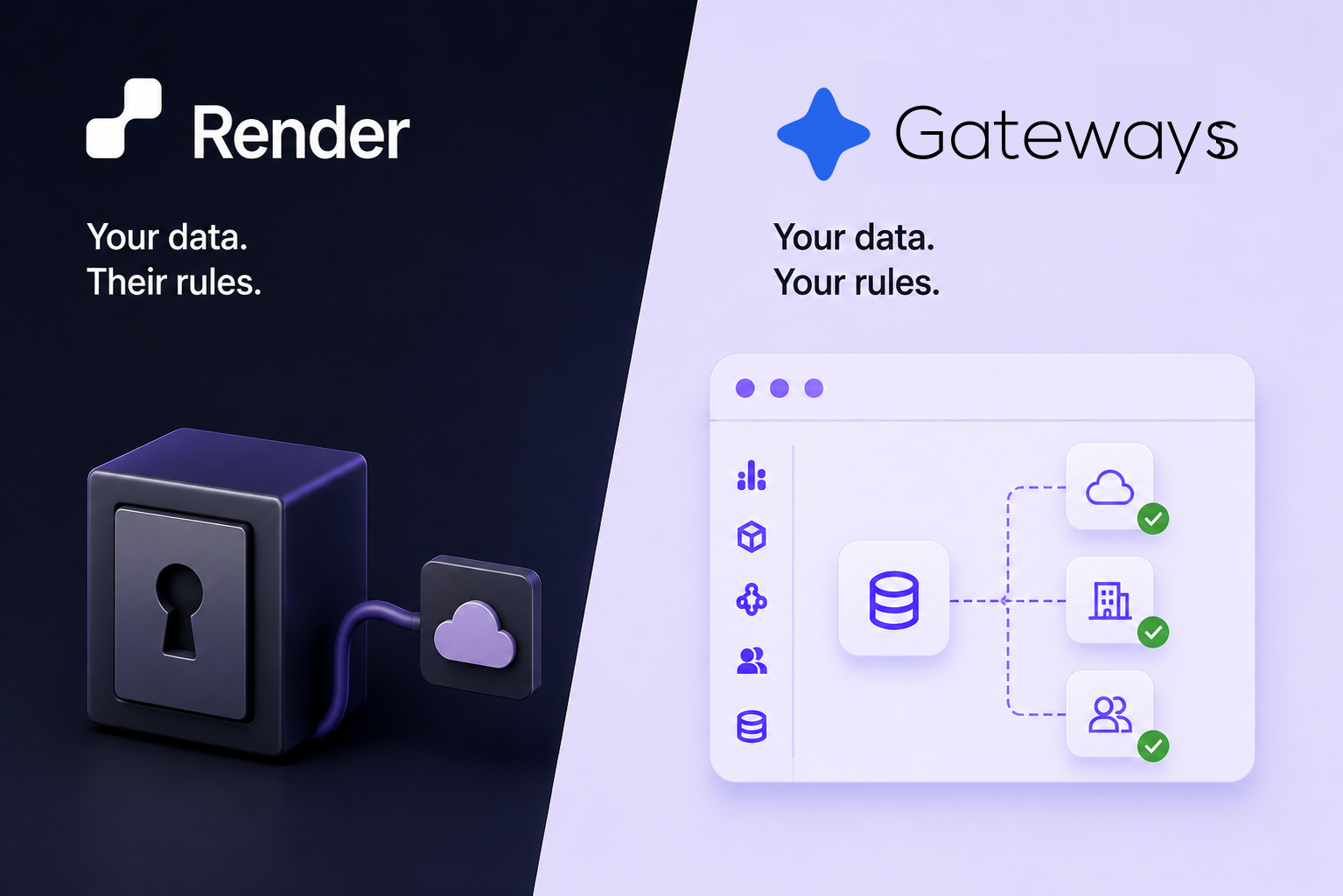
The core limitation of Render is simple:
Your workloads run on Render’s infrastructure - not your own cloud account.
At first, this abstraction feels convenient. But over time, it introduces constraints around infrastructure visibility, provider flexibility, operational control, networking architecture and long-term portability.
With Render:
- Infrastructure is abstracted away
- Operational layers are platform-controlled
- And provider-level optimisation becomes limited
This creates a dependency on Render’s infrastructure model, pricing structure, and operational boundaries.
For teams expecting infrastructure complexity to grow, this becomes increasingly important.
☁️ Gateways Takes a Fundamentally Different Approach
Gateways is not another hosted PaaS.
Gateways is designed as:
A cloud operations console for infrastructure you own.
With Gateways:
- Applications run directly inside your AWS, GCP, or Azure account
- Infrastructure remains under your ownership
- Teams retain full provider-level flexibility
This creates a fundamentally different operational model.
Instead of abstracting infrastructure away entirely, Gateways makes infrastructure:
- Visual
- Operationally manageable
- And significantly easier to understand
The result is a platform that combines deployment simplicity with infrastructure ownership and cloud-native flexibility.
👀 Visual Infrastructure vs Hidden Infrastructure
One of the biggest operational differences between Render and Gateways is visibility. Render intentionally hides much of the underlying infrastructure. This simplifies onboarding, but also reduces visibility into service relationships, deployment topology, networking flows, and system dependencies.
As infrastructure grows, abstraction can become operationally limiting.
Gateways approaches this differently.
Instead of hiding infrastructure Gateways visualises it.
Applications, databases, storage systems, functions, firewalls, and services exist inside a live operational workspace where teams can:
- See infrastructure relationships
- Manage systems visually
- Organise environments
- And operate cloud resources in a more intuitive way
This becomes especially valuable for:
- Production-scale systems
- Multi-service applications
- And multi-region infrastructure
🌍 Multi-Cloud Flexibility Changes the Long-Term Equation
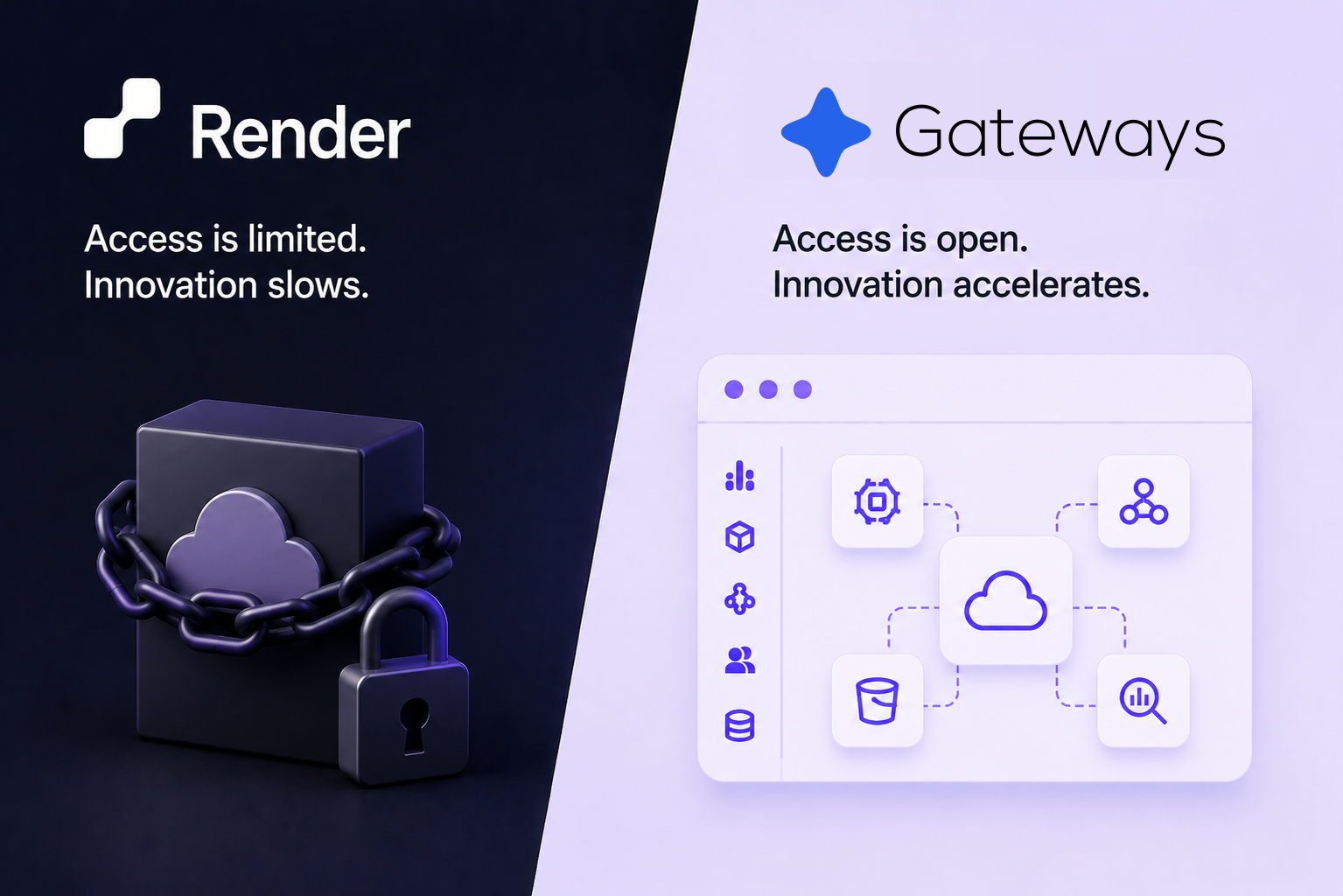
Render operates inside Render’s managed infrastructure layer. Whereas, Gateways allows teams to deploy into major cloud platforms including AWS, Google Cloud and Azure. This creates several major advantages for Gateways users.
✅ Avoid Vendor Lock-In
With Render, workloads become tightly coupled to the platform itself.
Migrating later may require:
- Infrastructure redesign
- Workflow changes
- And operational migration effort
With Gateways:
- Infrastructure remains inside your own cloud accounts from day one
- Workloads stay portable
- And provider flexibility remains fully intact
This dramatically reduces long-term platform dependency risk.
✅ Access Native Cloud Services Directly
As Gateways operates directly inside major cloud providers, teams can use:
- Native networking
- Provider IAM systems
- Cloud-native databases
- Storage services
- Monitoring systems
- And provider-level scaling infrastructure
This provides significantly more flexibility than a fully abstracted deployment platform.
✅ Better Multi-Region Architecture Support
Modern applications increasingly require:
- Global deployments
- Lower latency
- Redundancy
- And regional scalability
Gateways supports multi-region systems directly inside cloud-provider-native infrastructure environments.
This gives teams much greater architectural flexibility than relying entirely on a single hosted platform abstraction layer.
💸 Pricing: Where the Difference Starts Earlier Than Most Teams Expect
One of the biggest misconceptions in cloud infrastructure is:
“Managed platforms are cheaper for startups and small teams.”
That assumption is becoming increasingly outdated. Render’s simplicity comes with platform-level pricing overhead because:
- Workloads run on Render’s infrastructure
- Bandwidth is platform-controlled
- And infrastructure economics are tied to Render’s operational model
For example: Render’s Pro plans start around $25/month per user with 25 GB bandwidth included. With Gateways's Free plan and AWS free tier you get 100 GB bandwidth for Zero monthly cost.
Even modest production workloads can consume significant bandwidth surprisingly quickly.
☁️ Gateways Leverages Native Cloud Economics
Gateways works differently.
With Gateways, workloads run directly inside your own cloud account and teams benefit directly from:
- Cloud provider free tiers
- Provider native pricing
- Regional optimisation
- And infrastructure-level cost flexibility
For many smaller teams:
- AWS free-tier benefits alone can provide significantly more generous infrastructure economics than fully managed platforms.
This means Gateways can often provide:
- Lower infrastructure costs
- Better bandwidth economics
- And more optimisation flexibility even for smaller applications
📈 Cost Efficiency Improves Further at Scale
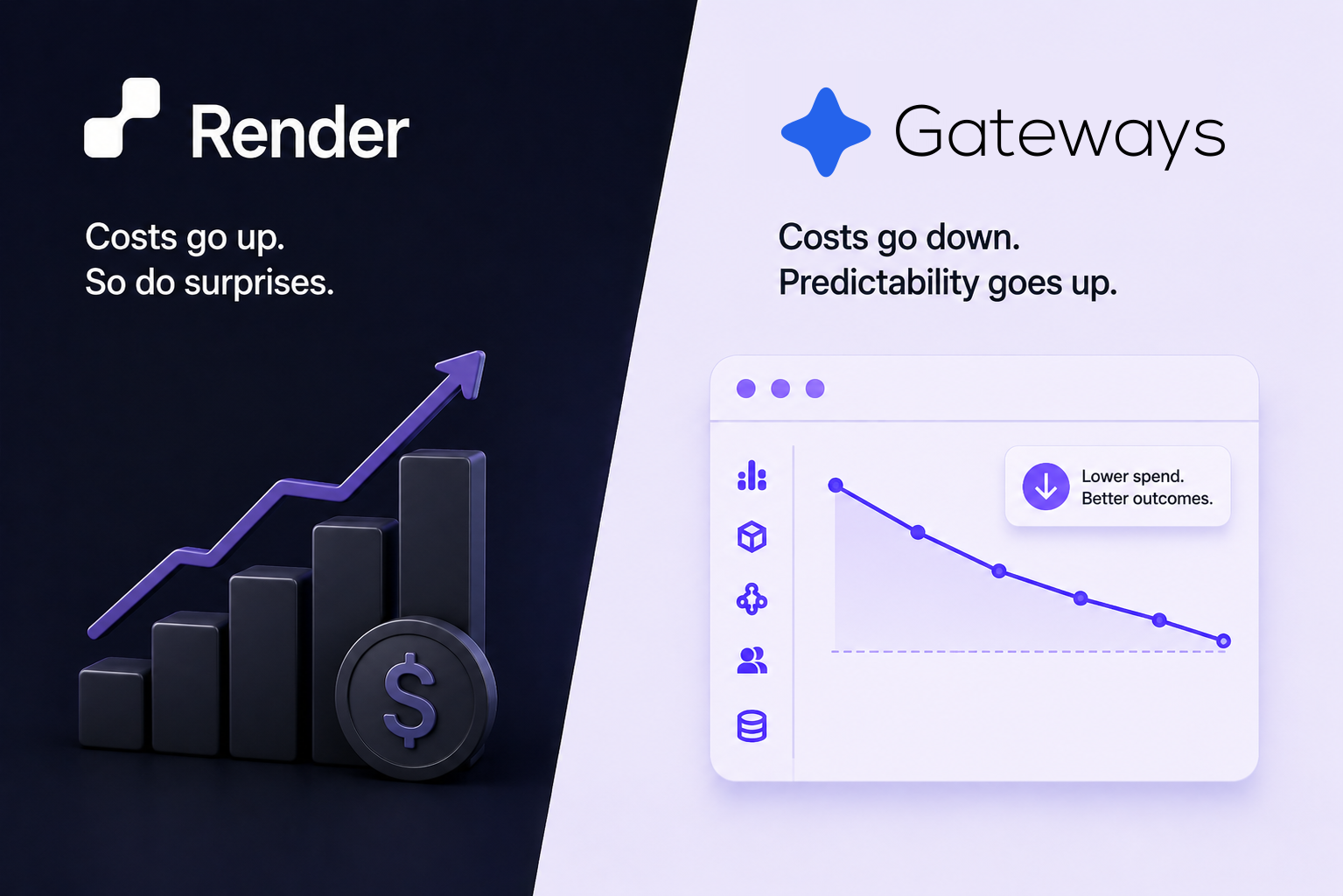
As systems grow, infrastructure costs increasingly revolve around compute, databases, storage, networking and bandwidth.
At that point, platform abstraction layers can become expensive operational bottlenecks.
With Render:
- Pricing flexibility is tied to platform-defined infrastructure models.
With Gateways:
- Teams optimise directly at the cloud-provider layer
- Choose preferred regions
- Architect workloads efficiently
- And leverage provider-native infrastructure economics
This creates significantly better long-term scalability economics.
🔄 Repeatable Infrastructure Without Heavy Infrastructure-as-Code Complexity
Render supports configuration-based deployments through render.yaml, which improves deployment consistency.
But Gateways expands this concept further through:
- Visual infrastructure management
- Environment cloning
- Reusable infrastructure templates
- And repeatable environment workflows
With Gateways, teams can:
- Clone environments
- Duplicate architectures
- Reuse infrastructure layouts
- And manage systems visually rather than entirely through code-heavy workflows
This creates a more operationally intuitive infrastructure experience.
🧠 Infrastructure as Code Improved Automation — Not Usability
One of the biggest operational problems in cloud infrastructure today is that:
Automation improved faster than usability.
Tools like Terraform made infrastructure programmable and repeatable.
But they also introduced large configuration files, operational abstraction and increasingly code-centric infrastructure management. Render solves this partially by hiding infrastructure complexity.
Gateways solves it differently:
Gateways makes infrastructure visual, understandable and easier to operate.
That creates a much more approachable operational model for teams that want:
- Infrastructure clarity
- Provider flexibility
- And operational simplicity
Without needing to manage everything through infrastructure code alone.
⚖️ Render vs Gateways: Philosophical Difference
| Render | Gateways |
|---|---|
| Hosted PaaS | Cloud operations platform |
| Runs on Render infrastructure | Runs in your cloud account |
| Infrastructure abstracted away | Infrastructure visualized |
| Simplicity-first | Simplicity + ownership |
| Limited provider flexibility | AWS + GCP + Azure support |
| Platform-defined economics | Cloud-provider economics |
| Easier onboarding | Better long-term scalability |
| Higher lock-in risk | Infrastructure portability |
The difference is not just technical. It’s philosophical.
Render optimizes for:
“Don’t think about infrastructure.”
Gateways optimises for:
“Own your infrastructure without operational complexity.”
Render can work well for side projects, smaller applications, prototypes, and teams prioritising immediate deployment convenience. Its managed workflows reduce operational friction early on.
Gateways is better suited for teams that want:
- Cloud ownership
- Multi-cloud flexibility
- Flexibility to suit infrastructure growth
- Long-term scalability economics
- Operational visibility without raw cloud complexity
It is especially valuable for organisations that want the simplicity of modern deployment platforms without sacrificing:
- Infrastructure flexibility
- Provider choice
- Or long-term operational control
🏁 Final Thoughts
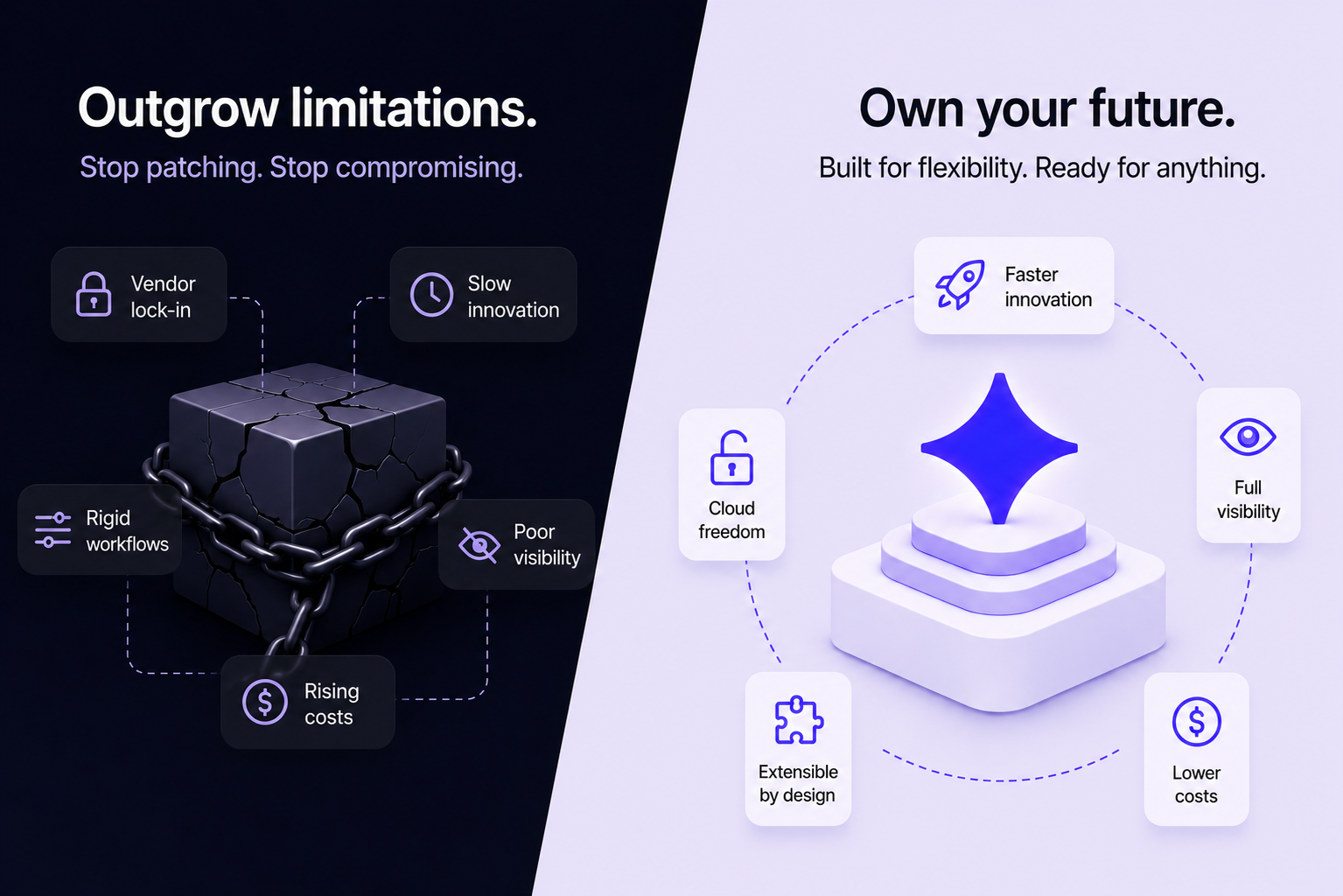
Render helped improve developer experience by simplifying deployment workflows. But modern infrastructure needs are evolving. Today, teams increasingly want simplicity, no vendor lock-ins, infrastructure ownership, no operational complexity and cloud-native economics, without losing deployment speed. That’s the gap Gateways is built to solve.
The future of cloud infrastructure is not just about hiding complexity.
It’s about making infrastructure:
- Visible
- Manageable
- Portable
- And operationally intuitive
inside the cloud environments teams already own.