
The Difference Between Hosting Platforms and Cloud Operations Platforms
For many teams, the first infrastructure decision is not really about infrastructure at all. It is about getting an application online as quickly as possible.
A developer pushes code to GitHub, connects a repository to a hosting platform, configures a few environment variables, and ships. This experience has become the benchmark for modern developer tooling. It is fast, accessible, and dramatically better than manually provisioning servers, configuring reverse proxies, managing TLS certificates, and stitching together deployment scripts from scratch.
That is why hosting platforms became so popular.
Vercel, Render, Railway, Netlify, Fly.io, Heroku, and similar platforms helped normalize a simpler deployment experience. Vercel, for example, supports deployments through Git, CLI, deploy hooks, and REST API workflows. Each successful deployment generates a unique URL that teams can use to preview changes in a live environment. Render web services similarly provide deployment workflows for applications, generated service subdomains, custom domains, private networking between Render services, environment variables, persistent disks, health checks, scaling options, zero-downtime deploys, TLS certificates, rollbacks, and more.
These platforms solved a real problem: deploying software used to be unnecessarily hard.
But as companies grow, deployment is only one part of the infrastructure lifecycle. Teams begin to care about cloud ownership, cost control, security boundaries, private networking, multi-region systems, cloud-provider choice, environment repeatability, operational visibility, and how resources connect across an architecture.
This is where the distinction between a hosting platform and a cloud operations platform becomes important.
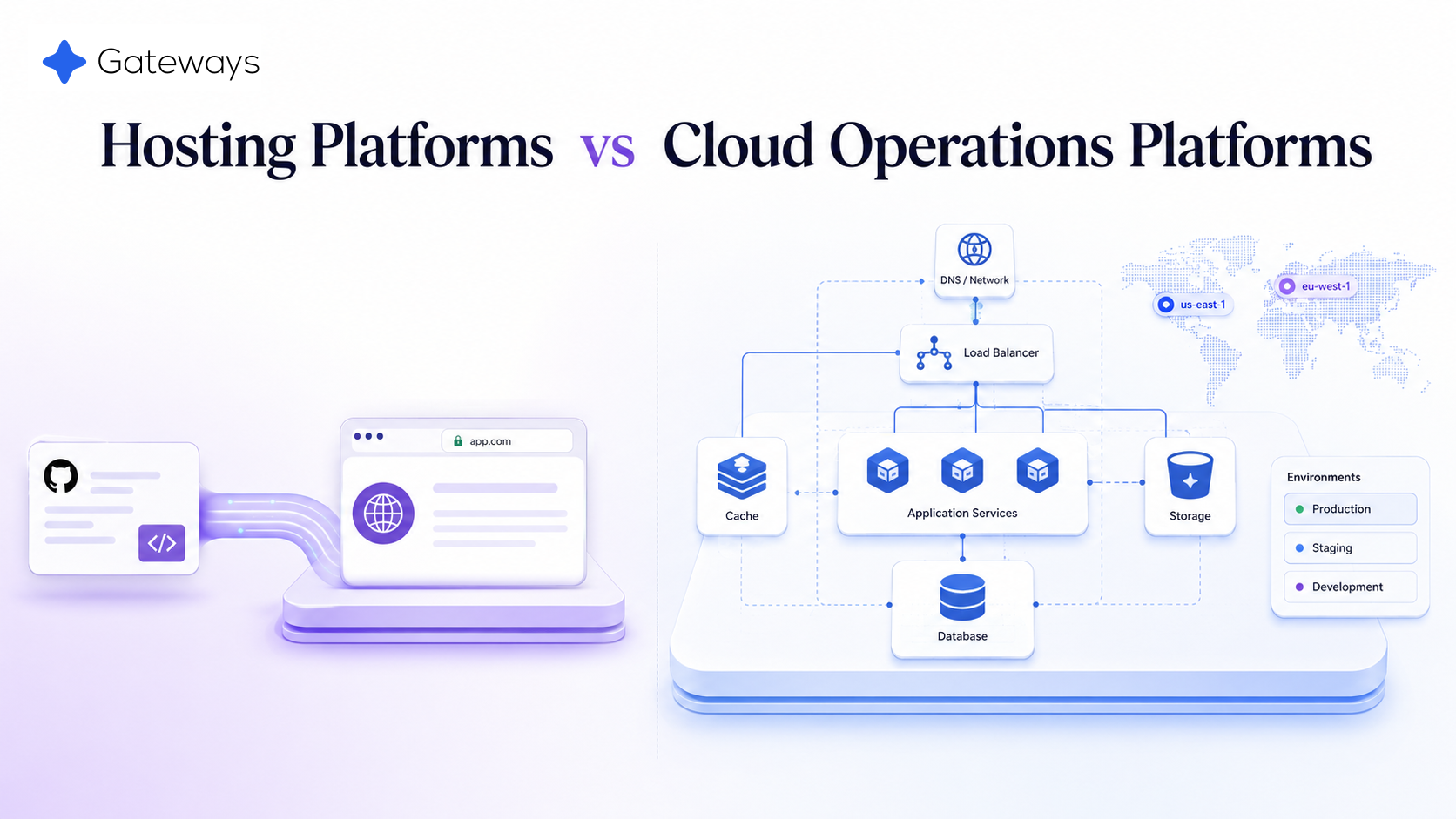
A hosting platform helps you deploy applications.
A cloud operations platform helps you deploy, understand, manage, connect, scale, and operate infrastructure as a system.
Gateways is built for this second category.
What Is a Hosting Platform?
A hosting platform is designed to make application deployment easier. Its primary value is speed: take code or a container, run it somewhere, expose it through a URL, and provide enough surrounding services to make deployment practical.
The best hosting platforms usually provide a polished workflow around common developer needs:
- Git-based deployment
- Build and runtime configuration
- Environment variables and secrets
- Custom domains
- TLS certificates
- Logs and deployment history
- Preview environments
- Rollbacks
- Basic scaling controls
- Databases or managed add-ons
- Static asset hosting or CDN integration
This is extremely valuable for early-stage products, frontend applications, marketing websites, MVPs, internal tools, prototypes, and teams that want to avoid infrastructure overhead.
The hosting platform experience is usually opinionated by design. The platform decides how workloads run, where the infrastructure boundary sits, how traffic is routed, which deployment primitives are exposed, how services communicate, what regions are supported, and what operational controls are available.
That opinionated experience is part of the appeal. It removes decisions. It compresses setup time. It gives developers an easier path from repository to production.
But the same abstraction that creates speed can also create limitations.
When teams run inside a hosting platform’s infrastructure model, they are often operating inside the platform’s boundaries. That may work well for a simple application, but it can become restrictive when architecture, security, compliance, cost, or operational requirements become more specific.
Where Hosting Platforms Start to Reach Their Limit
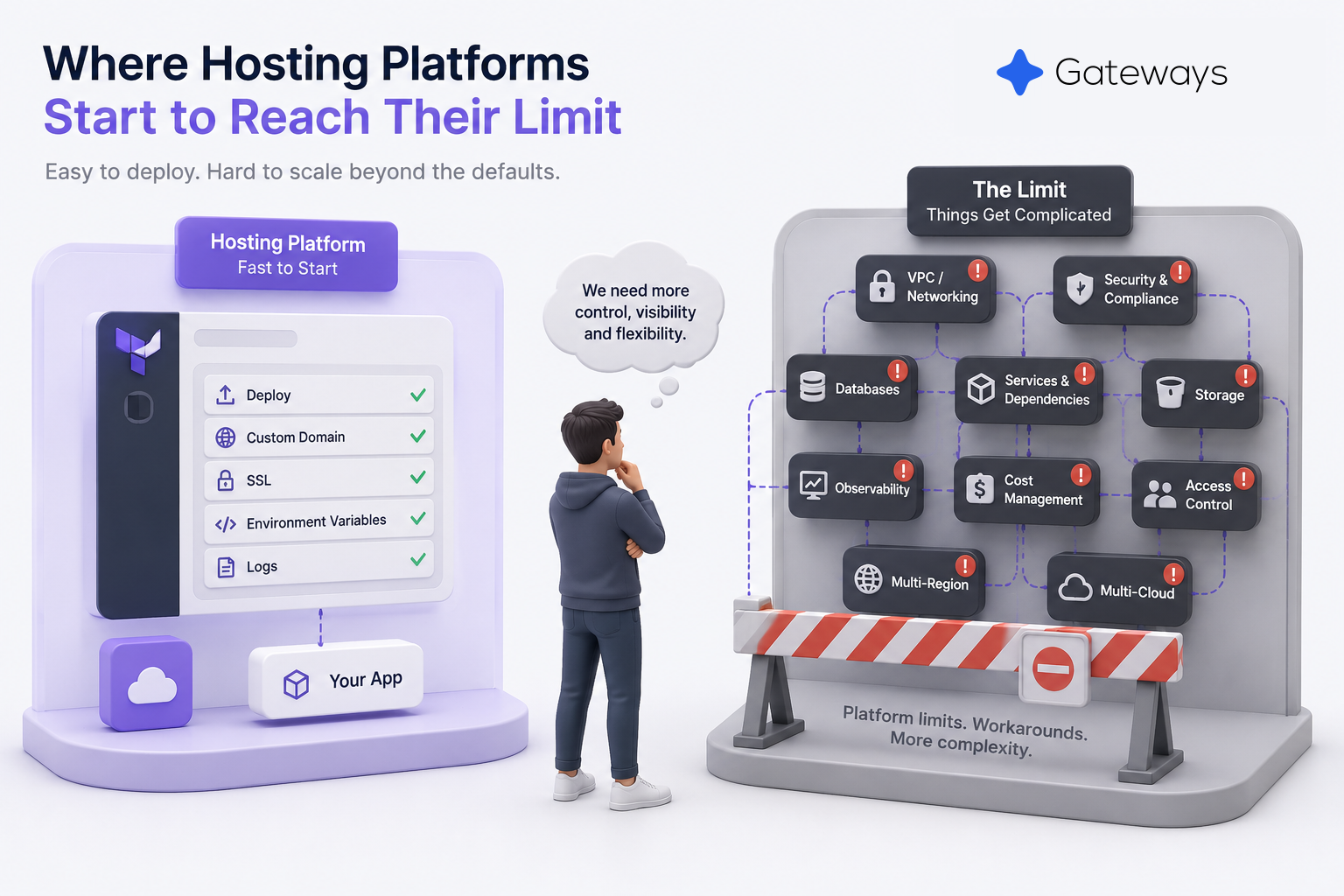
Most hosting platforms are optimized for deployment simplicity. They are not always designed to be the system of record for an organization’s broader cloud architecture.
This matters because a real production system is rarely just one deployable service. It may include application servers, databases, object storage, queues, caches, scheduled jobs, serverless functions, DNS records, certificates, firewalls, private networks, observability pipelines, access controls, regional replicas, and cost-management workflows.
A hosting platform can hide much of that complexity, but hiding complexity is not the same as giving teams control over it.
For developers, this often appears as a ceiling. The platform is easy at first, but when a team needs something outside the default model, it has to work around the abstraction. For decision makers, the concern is broader: infrastructure choices affect cost, portability, security posture, scaling strategy, and long-term optionality.
Common questions begin to emerge:
Can we run this workload in our own AWS, Azure, or Google Cloud account?
Can we use our existing cloud credits, reserved capacity, networking, IAM policies, and compliance controls?
Can our infrastructure remain operationally visible instead of being hidden behind the platform?
Can we model a full architecture, not just deploy individual services?
Can we clone a production-like environment without rebuilding everything manually?
Can we avoid future migration pain if platform costs, limits, or architecture assumptions no longer fit?
These are not simply hosting questions. They are cloud operations questions.
What Is a Cloud Operations Platform?
A cloud operations platform is broader than a hosting platform. Instead of focusing only on deploying applications, it provides an operating layer for managing cloud infrastructure across its lifecycle.
A strong cloud operations platform helps teams answer questions such as:
- What infrastructure exists?
- Where is it running?
- Which resources belong to which project or environment?
- Which services are connected?
- What depends on what?
- Which cloud provider and region are being used?
- What changed recently?
- How do we clone this setup?
- How do we scale this architecture?
- How do we manage resources without losing ownership?
In other words, a cloud operations platform is concerned with the system, not just the deployment.
This is where Gateways sits. Gateways is not just a hosted runtime. It is a visual cloud operations console for infrastructure that teams own. It is designed to help developers and technical teams deploy and manage resources across AWS, Google Cloud, and Azure while keeping those resources inside the customer’s cloud account.
That distinction is important.
A hosting platform typically says: “Deploy your app onto our platform.”
Gateways says: “Deploy and manage your infrastructure inside your cloud, with a simpler visual operating layer.”
The Ownership Difference
The most important difference between hosting platforms and cloud operations platforms is infrastructure ownership.
With many hosting platforms, teams deploy into infrastructure controlled or abstracted by the platform provider. The developer experience is smooth, but the underlying infrastructure boundary belongs to the platform. This is not inherently bad. For many applications, it is exactly what teams want.
But ownership becomes more important as the business matures.
Owning your cloud means the infrastructure is aligned with your organization’s accounts, security model, billing relationships, compliance posture, provider agreements, regions, and operational controls. It means the cloud account remains a strategic asset, not just an implementation detail hidden behind someone else’s deployment layer.
Gateways is built around this ownership model. Teams can use major cloud providers directly while still getting a simpler deployment and management experience. That is especially relevant for companies that already use AWS, Azure, or Google Cloud, or that expect to need deeper cloud control as they scale.
For CTOs and engineering leaders, this is not just a technical preference. It affects vendor strategy, cost leverage, operational risk, and migration optionality.
The Visibility Difference
Hosting platforms often simplify infrastructure by hiding it. Cloud operations platforms simplify infrastructure by making it understandable.
That difference matters.
When a platform hides infrastructure, teams may move faster initially, but they can lose architectural visibility. Developers may know that an app is deployed, but not have a clear picture of how it connects to databases, storage, regions, firewalls, DNS, or other services. Product leaders may see delivery velocity, but not understand the operational architecture behind the product. Finance teams may see platform invoices, but not have enough insight into infrastructure-level cost drivers.
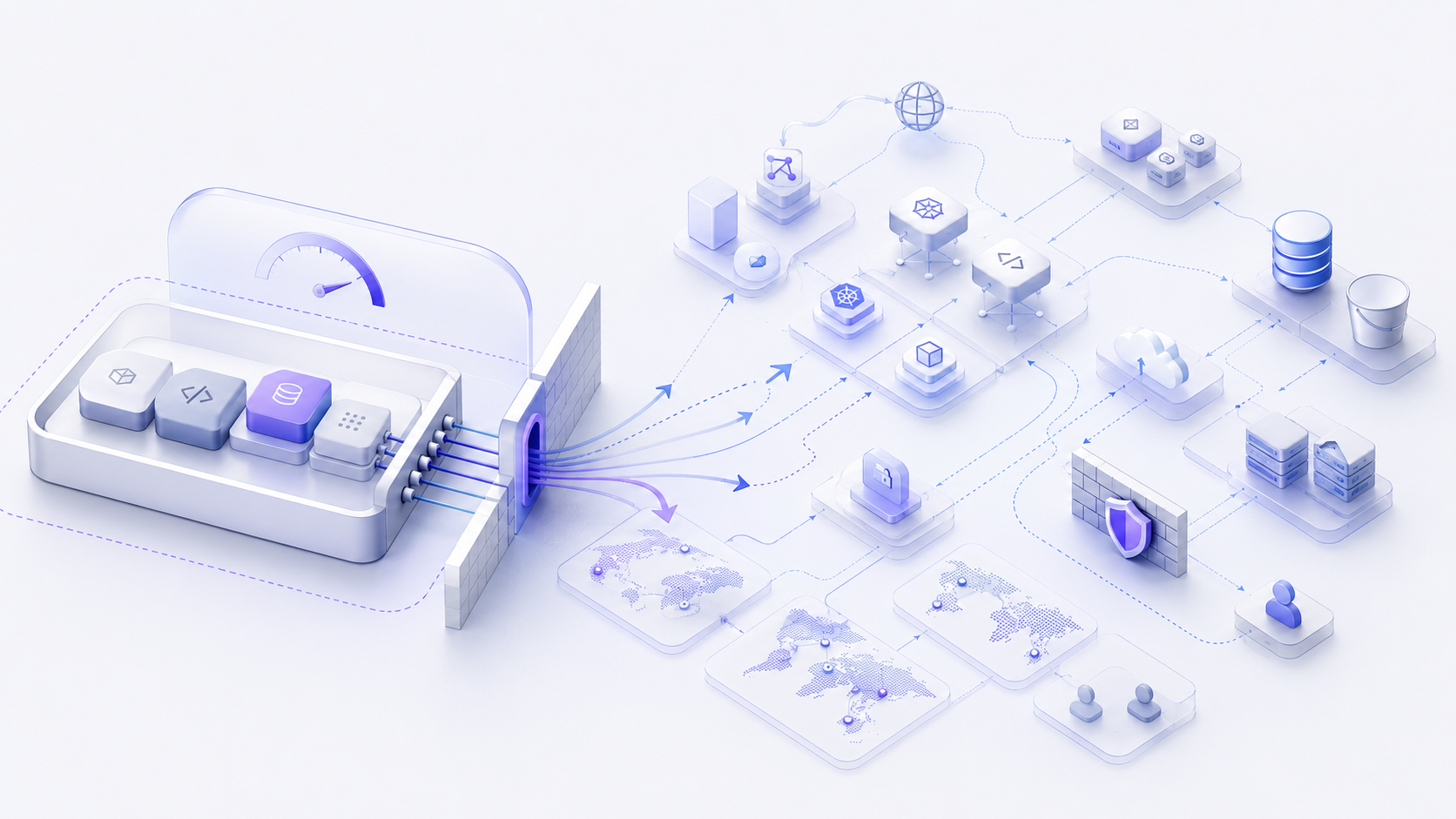
Gateways takes a visual-first approach. Infrastructure resources are represented on a canvas, making it easier to understand how systems are structured. Applications, databases, storage buckets, scalable servers, runtimes, DNS, subdomains, functions, and other resources can be organized visually across projects and environments.
This is not just a design feature. It changes how teams reason about infrastructure.
A visual system helps developers onboard faster, understand dependencies, review architecture, and troubleshoot operational issues. It helps decision makers see what is being built and how the underlying cloud footprint is evolving. It turns infrastructure from a hidden backend concern into a shared operational model.
The Environment Difference
Hosting platforms often provide environments in the context of deployments. For example, teams may have preview, staging, and production deployments tied to Git branches or deployment workflows. That is useful, especially for application delivery.
But infrastructure environments are broader than deployment targets.
A mature team may need:
- Development environments
- Staging environments
- Production environments
- QA environments
- Customer-specific environments
- Regional replicas
- Multi-cloud test environments
- Disaster recovery environments
- Temporary environments for experimentation
Managing these environments through a hosting platform alone can become limiting if the platform does not represent the full infrastructure architecture.
Cloud operations platforms are better suited to this broader environment model. Gateways supports repeatable environments by allowing teams to copy, clone, and template infrastructure patterns. Instead of manually recreating a setup or translating every decision into infrastructure code, teams can start from working architecture patterns and reuse them.
This matters because consistency is one of the hardest parts of cloud operations. A deployment platform can help ship code. A cloud operations platform helps teams manage the infrastructure context that code depends on.
The IaC Difference
Infrastructure as Code is another important part of this discussion.
Terraform is one of the most widely recognized tools in this category. HashiCorp describes Terraform as an infrastructure-as-code tool that lets teams define cloud and on-prem resources in human-readable configuration files that can be versioned, reused, and shared. Terraform can manage low-level components such as compute, storage, and networking, as well as higher-level components such as DNS entries and SaaS features. Terraform’s workflow is based on writing configuration, generating a plan, and applying approved changes, while its provider ecosystem includes AWS, Azure, Google Cloud, Kubernetes, Helm, GitHub, Datadog, and many other services.
IaC is powerful because it gives teams repeatability, reviewability, and automation. But it is not always the easiest operating model for every team. Infrastructure code can become difficult to read, hard to onboard into, and disconnected from the live operational view of the system.
This creates a gap.
Hosting platforms optimize for usability but often reduce ownership.
IaC optimizes for ownership and repeatability but can increase operational complexity.
Cloud operations platforms aim to combine the best of both: ownership, visibility, repeatability, and usability.
Gateways is positioned in that middle ground. It does not ask teams to abandon cloud ownership for convenience. It also does not force every infrastructure workflow to begin with configuration files. Instead, it gives teams a visual and operational interface for real cloud infrastructure.
Why Decision Makers Should Care
For developers, the difference between hosting and cloud operations often shows up as day-to-day workflow friction. For CTOs, CPOs, product managers, and founders, it shows up as strategic risk.
A hosting platform can be the right choice when speed is the only priority. But as the organization grows, infrastructure decisions become product decisions. They affect performance, customer trust, enterprise readiness, regional expansion, cost margins, reliability, and security.
A product leader should care whether infrastructure can support new customer requirements without months of rework. A CTO should care whether the team can scale without becoming trapped in an abstraction that no longer fits. A finance leader should care whether cloud spend is governed by the company’s own infrastructure strategy or by a platform pricing model. A security leader should care whether workloads live inside the company’s cloud boundary and governance practices.
This does not mean every team should avoid hosting platforms. It means leaders should understand what category of tool they are adopting.
If the problem is “we need to deploy a web app quickly,” a hosting platform may be enough.
If the problem is “we need a scalable, visible, repeatable, multi-environment, multi-cloud operating model for infrastructure we own,” then a cloud operations platform is the better category.
Where Gateways Fits
Gateways is designed for teams that want modern deployment simplicity without giving up cloud ownership.
It helps teams deploy and manage applications, servers, runtimes, storage, databases, DNS, serverless functions, and related cloud resources inside their own cloud accounts. It supports AWS, Google Cloud, and Azure, and brings these resources into a visual workspace where teams can see and manage infrastructure as connected systems.
This makes Gateways especially relevant for:
- Startups that want to avoid early infrastructure complexity but do not want future migration pain.
- SaaS teams that need repeatable environments.
- Developers who want a simpler interface for real cloud resources.
- CTOs who want ownership, portability, and provider choice.
- Product teams that need infrastructure visibility without requiring everyone to read Terraform modules or cloud console settings.
- Organizations that want the reliability and ecosystem of major cloud providers without the friction of managing everything manually.
Gateways is not trying to make cloud infrastructure disappear. It is trying to make cloud infrastructure usable.
That is a different philosophy from traditional hosting platforms.
Hosting Platforms vs Cloud Operations Platforms: A Practical Comparison
A hosting platform is usually best when the main job is deploying code quickly. It abstracts infrastructure so the team can focus on application delivery.
A cloud operations platform is best when the team needs deployment plus ownership, visibility, environment management, multi-cloud choice, and operational control.
The difference can be summarized this way:
| Area | Hosting Platform | Cloud Operations Platform |
|---|---|---|
| Primary focus | Deploy applications quickly | Operate infrastructure and applications as a system |
| Infrastructure boundary | Usually platform-owned or platform-abstracted | Customer-owned cloud infrastructure |
| Visibility | Often deployment/service-level | Architecture, resources, environments, and connections |
| Cloud choice | Limited by platform model | Designed around provider choice |
| Environment model | Deployment-centric | Infrastructure and project-centric |
| Best for | Fast app hosting | Long-term cloud operations |
| Strategic value | Speed and simplicity | Ownership, control, visibility, portability |
Gateways belongs in the second category.
Final Thoughts
The industry has spent years improving deployment. That work was necessary. Developers should not need to fight infrastructure just to launch an application.
But the next challenge is bigger than deployment.
Modern teams need to understand and operate infrastructure across environments, providers, regions, and services. They need deployment speed, but they also need ownership. They need simplicity, but not at the cost of visibility. They need abstraction, but not lock-in. They need a platform that helps them move fast today without limiting what they can build tomorrow.
Hosting platforms made deployment easier.
Cloud operations platforms make infrastructure manageable.
Gateways is built for teams that want both: a modern, visual way to deploy and operate cloud infrastructure, while keeping that infrastructure in their own AWS, Google Cloud, or Azure account. For developers, it reduces operational friction. For CTOs and product leaders, it preserves strategic control. For growing teams, it creates a clearer path from simple deployment to serious cloud operations.